Let’s Take A Bicycle Ride: What It’s Like To Bike On Local Roads in Las Vegas/Clark County
(Disclosure: LVSportsBiz.com publisher Alan Snel paused his newspaper reporting career in early 2006 to start a bicycle store coalition in the Tampa Bay market to work on road safety and bicycle awareness issues and worked 6 1/2 years on making road safety a public policy issue before moving to Las Vegas in late 2012 to work at the Review-Journal newspaper. After four Clark County students were killed by motorists while they walked/bicycled to and from school in the past year, Snel decided to use LVSportsBiz.com to report more on why Las Vegas/Clark County ranks low in road safety and bicyclist/pedestrian infrastructure.)
ADVERTISEMENTS
*

*

By Alan Snel, LVSportsBiz.com Publisher-Writer
LAS VEGAS, Nevada — I used to routinely take bicycle rides to the Strip corridor from my west Las Vegas Valley home.
No more.
It a rare bike ride to the Strip these days, perhaps once a month.
The reason: too many drivers operate cars that nearly crash into me.
There are hardy bicycle trails like you see in many city metro areas in the U.S. that are along my route and many of the roads are wide corridors with a limited number of bike lanes, protected bike lanes and trails along the roads. For me, bicycling is the highest form of transportation. The health benefits are a nice by-product and I take pride is subtracting a car from the Las Vegas traffic flow.
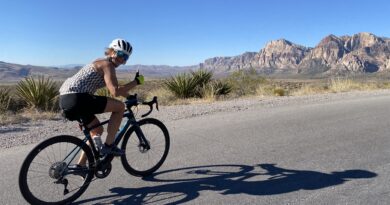
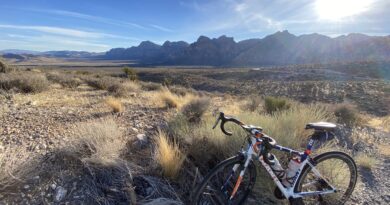
This afternoon I biked a 50-mile route from my new home out near State Routes 159 and 160 to the Strip corridor and downtown Las Vegas and back to my Red Rock Canyon area home.
ADVERTISEMENT

ADVERTISEMENT
The early part of the bike ride featured a gorgeous bike lane stretch on Fort Apache Road thanks to the pro-bicycle safety policies of Clark County Commissioner Justin Jones, who played a major role in the long-awaited start of construction of the Red Rock Legacy Trail last summer. The Legacy Trail is a paved bicycle trail that is planned along the State Route 159 corridor through Red Rock Canyon from the suburban Summerlin area to State Route 160.
From Fort Apache Road I took a right turn on Warm Springs Road and that’s where the LVSportsBiz.com videos begin. This ride was from 1:30PM-5:30PM, so I tried to avoid any rush hour traffic during the first part of the ride.
The main observation along my route is that there are wide corridors that could easily include bike lanes, protected bike lanes and paved trails along the roads if local government wanted to invest in that. Another observation is that roads in Clark County will go from three traffic lanes in one direction to a single traffic lane.
Then it was a turn on Valley View Boulevard. This is another wide corridor with the opportunity to take one of the three traffic lanes and convert it into a buffered bike lane:
From Valley View Blvd. it was a right turn on Hacienda Avenue, which has two lanes without a bike lane that heads to the Strip. Hacienda Ave. is a crucial road because it’s the most calm east-west road that has a bridge that spans Interstate 15 and heads to the Strip at the Luxor and Mandalay Bay.
I followed Frank Sinatra Drive and Sammy Davis Jr. Drive behind the Strip hotels west of Las Vegas Boulevard.
Again, no bike lanes.
I made a left turn on Bonneville/Alta Drive, a popular east-west route for bicyclists heading to downtown Las Vegas.
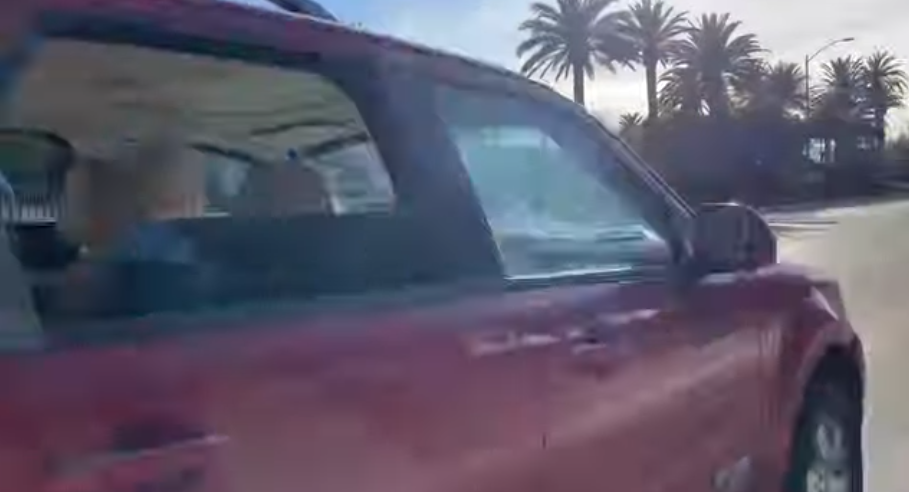
The road is a decent bicycle route, but things change west of the Buffalo Drive intersection where the city of Las Vegas expanded the single lane to two lanes and reduced space in the bike lane. This is a bad road design for bicyclists because now motorists buzz cyclists, violating the law that requires drivers to pass a bicyclist by at least three feet. Take a look. This video documents a driver violating the three-foot buffer and shows exactly where the city of Las Vegas increased the one westbound lane to two westbound lanes. Like I mentioned, bad road design.
Here’s where a motorist came close to me:
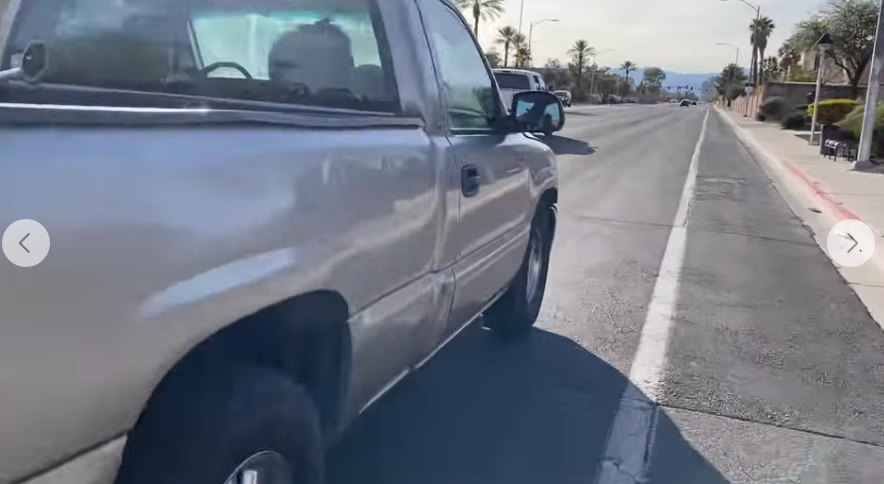
As I head west and pass the Durango Drive, the bike lane narrows even more even though there’s so much road space in a center lane that I have never seen used by a motorist. The bike lane is so narrow that it’s hard to believe it’s a legal bike lane. Part of the bike lane is the concrete gutter — a horrible and awful piece of bicycle infrastructure in Las Vegas. Take a look at the concrete and asphalt combo in the bike lane — dangerous stuff because the city gave two traffic lanes to motorists and expect bicyclists to use this too narrow bike lane:
From Alta Drive, I took the 215 trail to West Charleston Avenue. Even though I did not bike that dangerous at-grade 215 crossing at West Charleston I wanted to show that the curb cut to allow bicyclists to enter the road to cross Charleston was done at a 45-degree angle into the intersection where drivers coming off the 215 are making right turns onto Charleston and potentially into crossing bicyclists. Take a look at a driver making that turn in front of this poorly-designed curb cut:
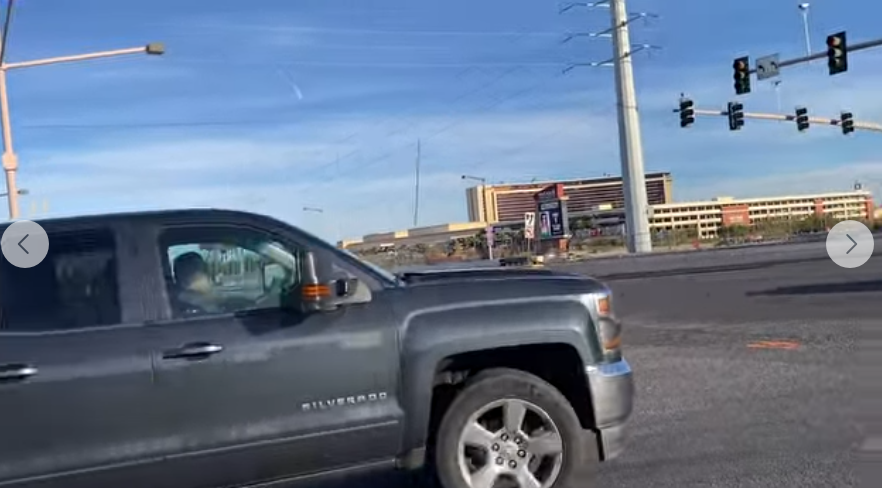
This video shows the 215 crossing at Charleston in a much more graphic fashion:
Finally, the Sky Vista Drive/West Charleston Avenue (Route 159) traffic light is working. This intersection included a ridiculous left turn at a stop sign from Sky Vista onto Charleston where motorists routinely ran the stop sign and crashed into bicyclists, walkers and other motorists on Charleston/SR 159. The video shows the new traffic signal and the beginning of the paved trail along SR 159 leading to the hill and Red Rock Canyon
The ride along SR 159 through Red Rock Canyon, but the shoulder should be wider. I have reduced my time biking along 159 because motorists sometimes drive on the shoulder near bicyclists. I know many people who have stopped riding their bicycles on the 159 shoulder because they believe it’s not safe and that drivers will hit them.
That 159 bike trail can’t open fast enough.
If you appreciate this coverage and want to buy an ad on this site, contact Alan Snel at asnel@LVSportsBiz.com
*
PSA
*
Buy a book!